

CG Policy · 2025
In this section7 topics
Corporate Governance Policy
Sub-Section Introduction
The Board of Directors of AIRA Factoring Public Company Limited (“the Company”) recognizes and places great importance on good corporate governance, which serves as a fundamental foundation for conducting business with transparency, fairness, and accountability toward shareholders and all stakeholder groups. This approach supports the creation of sustainable long-term value for the Company.
The Company has established written corporate governance policies and practices based on the Corporate Governance Code for Listed Companies 2017 (CG Code) issued by the Securities and Exchange Commission, together with internationally recognized best practices. These policies serve as a framework guiding the operations of the Board of Directors, executives, employees, the Company, and its subsidiaries to ensure alignment in governance standards and business conduct.
The Company does not necessarily structure its policies strictly according to each specific category of the CG Code. Instead, it formulates governance policies that are appropriate to the nature of its business, organizational structure, and operational context. This approach ensures that such policies can be effectively implemented in practice and genuinely reflect effective corporate governance.
The Company also requires that the Corporate Governance Policy and related policies be reviewed on an annual basis to ensure they remain up to date and consistent with applicable laws, regulatory requirements, and evolving corporate governance practices. These policies are disclosed on the Company’s website under the “Investor Relations” section and are communicated to directors, executives, and employees at all levels through internal communication channels to ensure strict adherence.
In addition, the Company discloses the full versions of its corporate governance policies, guidelines, and relevant charters as supporting documents. This enables shareholders, investors, and stakeholders to review and understand the Company’s governance framework and to monitor the Company’s business direction in a transparent and accountable manner.
Has a Corporate Governance Policy
Yes
Policy Description
Overview of Corporate Governance Policies and Practices
AIRA Factoring Public Company Limited (“the Company”) conducts its business in accordance with the principles of good corporate governance, emphasizing transparency, fairness, accountability, and consideration of the best interests of shareholders and all stakeholder groups. The Company has established written corporate governance policies to serve as a framework for conducting business and overseeing management operations in compliance with applicable laws, regulations, and the standards of regulatory authorities, as well as in alignment with the corporate governance practices of the Thai capital market.
The Company is committed to conducting its business with responsibility, transparency, and accountability. Directors, executives, and employees at all levels are encouraged to uphold the principles of good governance, business ethics, and responsibility toward society and the environment. This approach aims to build confidence among shareholders, investors, and stakeholders while supporting the Company’s stable and sustainable long-term growth.
Key Principles of Corporate Governance Practices
Rights of Shareholders and Equitable Treatment of Shareholders
The Company respects and protects the fundamental rights of all shareholders on an equitable basis, whether they are major shareholders, minority shareholders, or foreign investors. Shareholders are given opportunities to participate in key decisions of the Company through shareholders’ meetings, voting, proposing meeting agendas, and nominating qualified individuals for appointment as directors in advance. Shareholders are also provided with accurate, complete, and sufficient information to support their investment decisions. In addition, the Company has established measures to prevent the misuse of inside information for personal benefit.
Shareholders’ Meetings
The Company organizes shareholders’ meetings in accordance with good corporate governance principles. Meeting notices and supporting documents are delivered to shareholders in advance within the timeframe prescribed by law. Shareholders are provided with opportunities to raise questions, express opinions, and provide recommendations to the Board of Directors and the Management. Shareholders’ meetings therefore serve as an important forum for communication and mutual understanding between the Company and its shareholders.
Role of Stakeholders
The Company recognizes the importance of all stakeholder groups, including shareholders, employees, customers, trade debtors, business partners, competitors, creditors, regulators, communities, and society. The Company conducts its business responsibly while considering the mutual interests of all parties. Emphasis is placed on compliance with laws and regulations, protection of labor rights, employee development, and employee welfare. The Company also supports activities that contribute to social and environmental development.
Disclosure and Transparency
The Company places importance on the disclosure of accurate, complete, timely, and transparent information to shareholders, investors, and stakeholders. Financial information and other material information are disclosed through various channels, including the Annual Report, the 56-1 One Report, the Company’s website, and the disclosure system of the Stock Exchange of Thailand. This ensures that investors have equal access to information necessary for making investment decisions.
Roles, Duties, and Responsibilities of the Board of Directors
The Board of Directors is responsible for determining the Company’s vision, policies, strategies, and business direction, as well as overseeing the Management to ensure that operations are carried out effectively in accordance with the established policies and objectives. The Board also regularly monitors the Company’s operating performance, risk management, and internal control systems to ensure that the Company maintains an appropriate governance framework and is able to create long-term value for shareholders.
Nomination and Remuneration of Directors and Executives
The Company has established the Nomination, Remuneration and Corporate Governance for Sustainability Committee, which is responsible for selecting qualified individuals for appointment as directors and executives. The Committee also determines appropriate remuneration structures and criteria that are aligned with roles, responsibilities, and performance, with the objective of motivating personnel to perform their duties effectively and transparently.
Prevention of Conflicts of Interest and Anti-Corruption
The Company has established clear policies and guidelines regarding the prevention of conflicts of interest. Directors, executives, and employees are required to disclose any personal interests that may be related to the Company’s business operations and must refrain from participating in the consideration of such matters. In addition, the Company has adopted an anti-corruption policy that prohibits all forms of corruption and has established internal control measures to prevent and detect any improper conduct.
Whistleblowing and Protection of Whistleblowers
The Company has established channels for stakeholders to report any suspected misconduct or actions that may violate laws, business ethics, or the Company’s regulations. Measures are in place to protect whistleblowers from retaliation or adverse consequences arising from the reporting of such information. All reports are subject to fair and transparent investigation procedures.
Internal Control and Risk Management
The Company has established internal control mechanisms and a risk management system appropriate to the nature of its business. The Audit Committee oversees compliance with applicable laws, policies, and relevant standards, and monitors the effectiveness of the Company’s internal control and risk management systems on a continual basis.
Board Development and Performance Evaluation
The Company conducts annual performance evaluations of the Board of Directors, Board committees, and individual directors in order to enhance the effectiveness of the Board’s performance. In addition, the Company supports directors and executives in attending training programs and continuing education related to business, laws, and corporate governance.
Executive Succession Planning
The Company places importance on the development of executive capabilities and succession planning to ensure that qualified individuals are prepared to assume key leadership positions in the future, thereby supporting the continuity and sustainability of the Company’s business operations.
Policy & Practices — Board of Directors
Introduction
The Company has established written policies, charters, and guidelines relating to the Board of Directors to serve as a framework for governing the roles, duties, and responsibilities of the Board of Directors and its subcommittees. These are aligned with the Corporate Governance Code for Listed Companies 2017 (CG Code) and the guidelines of relevant regulatory authorities. The objective is to ensure that the Board performs its duties independently, transparently, and effectively. The Company also requires that such policies and guidelines be regularly reviewed and updated to ensure alignment with the Company’s business environment and strategic direction.
Has Policy & Guidelines for the Board
Yes
Board Guidelines
| Guideline | Other — Please Specify | Detail | |||||||||
|---|---|---|---|---|---|---|---|---|---|---|---|
| Nomination of Directors | The Company establishes a nomination and selection process for directors based on the principles of transparency, fairness, and alignment with the Company’s business strategy and direction. Consideration is given to an appropriate board structure and composition, including the number of directors, the proportion of independent directors, non-executive directors, and the diversity of skills, knowledge, and experience necessary for effective corporate governance at each stage of the Company’s development. The Company considers candidates based on their knowledge, capabilities, experience, suitability for the nature of the business, and their ability to perform duties effectively as directors. The selection process is conducted without discrimination on the basis of race, language, religion, gender, age, marital status, or physical limitations. The Company also emphasizes Board Diversity and considers the skills that the Board may still lack by referencing the Board Skill Matrix, ensuring that the Board’s composition remains appropriate and capable of supporting effective governance and business oversight. Given that the Company operates in the factoring business, it has identified key core business skills that are essential for governance and strategic direction, including:
These skills are directly relevant to the oversight of credit businesses, credit analysis, liquidity management, and risk management in the factoring industry. Director Nomination Criteria The Company establishes the following criteria for the nomination of directors:
Opportunity for Shareholders to Nominate Directors The Company provides shareholders with the opportunity to nominate qualified individuals for consideration for election as directors in advance for a period of three months each year, from 1 October to 31 December. The criteria, procedures, and nomination process are disclosed on the Company’s website to ensure that shareholders can exercise this right on an equitable and transparent basis in accordance with good corporate governance principles. Sources of Director Candidates The Nomination, Remuneration and Corporate Governance for Sustainability Committee considers potential candidates from various sources, including:
Director Nomination and Selection Process The Company has established a systematic nomination and selection process for directors. The process begins with a review of the Board structure, composition, and required skills based on the Board Skill Matrix to ensure alignment with the Company’s business strategy and direction. Qualified candidates who meet the established criteria are then identified and proposed to the Board of Directors for consideration and approval, or subsequently proposed to the shareholders’ meeting for approval as required. In the case of directors who complete their term and are nominated for reappointment, the Nomination and Remuneration Committee considers factors such as their performance, continuity in governance oversight, meeting attendance, and the relevance of their skills and experience to the Company’s business strategy. Performance in 2025 In 2025, the Company undertook the nomination process for a new executive director to replace an executive director whose term had expired. The Nomination and Remuneration Committee conducted the nomination process in accordance with the established procedures, taking into consideration qualifications, knowledge, capabilities, and experience consistent with the Board Skills Matrix and the Company’s needs, before proposing the candidate to the Board of Directors and subsequently to the shareholders’ meeting for approval. The selected executive director possesses knowledge and experience relevant to the Company’s business, particularly in the areas of financial institutions, finance, and business administration, which are aligned with the Company’s strategic direction and support the effective governance and management of the Company’s business operations. | ||||||||||
| Determination of Director Remuneration | Director Remuneration Policy The Company places importance on determining directors’ remuneration in accordance with the principles of good corporate governance, taking into consideration appropriateness, transparency, and fairness. The remuneration structure is aligned with the roles, duties, responsibilities, and performance of directors in order to motivate them to perform their duties effectively and independently, while contributing to the long-term value creation of the Company. The Company has established written policies and criteria for determining the remuneration of directors, the Chief Executive Officer, and senior executives. These policies are reviewed on an annual basis to ensure alignment with the practices of listed companies, capital market standards, and the guidelines of the Thai Institute of Directors Association (IOD). Structure and Criteria for Determining Directors’ Remuneration The determination of directors’ remuneration takes into consideration several key factors, including:
The Company’s directors’ remuneration consists of two main components: 1. Meeting Allowance 2. Directors’ Bonus Remuneration Governance and Approval Process The determination of directors’ remuneration is subject to a clear and transparent governance process, as follows:
The Board of Directors considers that the remuneration structure is appropriate and consistent with the responsibilities of directors. It is designed to motivate directors to perform their duties effectively and is comparable with remuneration practices within the same industry. | ||||||||||
| Independence of the Board of Directors from the Management | The Company places importance on maintaining the independence of the Board of Directors from the Management to ensure effective and transparent corporate governance and to establish an appropriate balance of authority in management oversight. To achieve this, the Company has established clear policies, structures, and practices that systematically separate the roles, duties, and responsibilities of the Board of Directors and the Management, in line with the principles of good corporate governance. 1. Separation of Roles between the Board of Directors and the Management The Company clearly separates the roles of the Chairman of the Board and the Chief Executive Officer, ensuring that these positions are held by different individuals. This structure helps prevent the concentration of authority and enables the Board to perform its oversight, monitoring, and advisory functions independently. The Board of Directors is responsible for determining the Company’s policies, vision, strategies, and business plans, as well as overseeing the overall operations of the Company without interfering in day-to-day management activities. Meanwhile, the Management, led by the Chief Executive Officer, is responsible for the day-to-day operations and the implementation of strategies and policies approved by the Board of Directors. 2. Independence of the Chairman of the Board The Company designates the Chairman of the Board as an Independent Director who does not participate in the Company’s day-to-day management. This ensures that the Chairman can perform the role of leading the Board with neutrality and promote the independent judgment of all directors. The Chairman of the Board plays an important role in:
3. Board Structure and Proportion of Independent Directors The Board of Directors consists of members with diverse qualifications, knowledge, and experience. The Company requires that independent directors comprise at least one-third of the total number of directors and not fewer than three persons, in accordance with regulatory requirements. This structure enhances the independence of the Board’s oversight and reduces the potential influence of the Management or major shareholders. Independent directors must not be involved in management functions, must have no financial interests that may affect their independence, and must be able to express opinions freely while prioritizing the best interests of the Company and its stakeholders. 4. Measures to Prevent Conflicts of Interest The Company has established guidelines requiring directors who have an interest or potential conflict of interest in any agenda item to abstain from providing opinions and voting on that matter. This measure ensures independence and transparency in the Board’s decision-making process. In addition, the Board of Directors may request information, supporting documents, or advice from independent external advisors when necessary to support prudent and independent decision-making, separate from the Management. 5. Oversight of Management and Reporting The Management is required to report operating results, key information, and material matters to the Board of Directors in a complete, transparent, and timely manner. This enables the Board to effectively perform its oversight duties and evaluate the performance of the Management. Furthermore, if the Chief Executive Officer intends to hold a position in another company, prior approval from the Board of Directors is required in order to prevent potential conflicts of interest and to ensure that the Chief Executive Officer can fully devote his or her time and effort to performing duties for the Company. | ||||||||||
| Director Development | The Company places importance on developing and strengthening the capabilities of the Board of Directors to ensure that the Board can perform its governance duties effectively, comprehensively, and in alignment with the principles of good corporate governance. This also enables the Board to respond appropriately to evolving business environments, emerging risks, and increasingly complex sustainability-related issues. To this end, the Company has established systematic policies and practices for director development, focusing on enhancing the knowledge, skills, and strategic perspectives necessary for directors in each role. This approach aims to strengthen the Board’s capacity to provide effective governance and to create long-term value for the organization. Promotion and Support for Directors’ Knowledge Development The Company supports directors in continuously participating in training programs, seminars, and knowledge development activities relevant to their roles and responsibilities. These programs cover various areas such as corporate governance, risk management, audit oversight, finance, digital technology, and environmental, social and governance (ESG) issues. Directors may attend training programs organized by reputable and recognized institutions, including:
Such support aims to ensure that directors acquire up-to-date knowledge that can be applied in corporate governance practices and contribute to enhancing the overall effectiveness of the Board. Training Aligned with Directors’ Roles and Responsibilities The Company emphasizes selecting training programs that are aligned with the roles, responsibilities, and duties of directors in each position. Directors are encouraged to attend programs relevant to their roles, whether as members of the Board of Directors, independent directors, or members of Board committees. In 2025, the Company’s directors participated in various training programs and seminars covering key topics such as ESG risk management, the role of independent directors, audit oversight, strategies for director nomination and remuneration, the role of the Chairman of the Board, and the application of technology and artificial intelligence (AI) to support corporate governance. These activities reflect the Company’s commitment to enhancing directors’ competencies in line with the evolving business environment and future trends. Continuous Director Development and Readiness The Company emphasizes that director development is a continuous process and not limited to training at any particular period. Importance is placed on preparing directors to effectively perform their duties through continuous enhancement of knowledge, awareness of emerging risks, and proactive governance practices. This enables the Board to provide strategic guidance and oversee management appropriately and independently. Role of the Company Secretary in Supporting Director Development The Company assigns the Company Secretary the responsibility of supporting and coordinating director development initiatives. The Company Secretary regularly informs directors of relevant training programs, seminars, and activities related to corporate governance. In addition, the Company Secretary supports newly appointed directors by ensuring that they receive appropriate orientation and an understanding of their roles and responsibilities in accordance with good corporate governance principles. Furthermore, the Company emphasizes the continuous development of the Company Secretary’s knowledge and competencies to ensure effective support to the Board of Directors, provide advice on regulatory requirements, and promote the Company’s corporate governance practices in alignment with capital market best practices. Linking Director Development with Corporate Governance and Sustainability The Company’s policies and practices for director development are integrated with its corporate governance framework, organizational strategy, and sustainability initiatives. This approach aims to strengthen the Board’s ability to oversee the Company comprehensively while considering the interests of shareholders and stakeholders, thereby supporting the Company’s stable and sustainable long-term growth. | ||||||||||
| Board Performance Evaluation | The Company places importance on the evaluation of the performance of the Board of Directors as a key mechanism for enhancing the effectiveness of corporate governance and supporting the continuous development of the organization. The performance evaluation is conducted under the Corporate Governance Policy for 2025 and in alignment with the principles of good corporate governance. The Company requires that the performance of the Board be evaluated annually, covering all levels of the Board, including the Board of Directors and all Board committees, through both individual and collective assessments. This approach reflects both the effectiveness of each director’s performance and the overall effectiveness of the Board’s collaborative functioning. Evaluation of the Performance of the Board of Directors and Board Committees Evaluation Format and Scope The Company conducts annual performance evaluations of the Board of Directors and all Board committees through a self-assessment process, covering both individual and collective evaluations. The Company does not conduct a separate individual evaluation of the Chairman of the Board; instead, the Chairman’s performance is included as part of the overall evaluation of the Board. In addition, the Company conducts an assessment of the diversity of skills, knowledge, and expertise of the Board (Board Skills Matrix). This assessment is used as supporting information in determining the appropriateness of the Board’s composition and as a reference for planning director development in alignment with the Company’s strategic direction and business objectives. Objectives of the Evaluation The objectives of the performance evaluation are to:
Evaluation Process The Company prepares evaluation forms that cover key aspects of the Board’s responsibilities, including understanding of the business, strategic oversight, risk management oversight, ESG governance, adherence to corporate governance principles, and participation in Board meetings. The evaluation results are compiled, analyzed, and presented to the relevant committees and the Board for acknowledgment and for consideration in improving the Board’s performance in subsequent periods. The Company does not engage external consultants to conduct the evaluation. Instead, emphasis is placed on transparency, independence, and candid reflection in the evaluation process to ensure that the results provide meaningful insights for practical improvement. | ||||||||||
| Other guidelines regarding the board of directors | Disclosure of the Company's Securities Trading and Holdings | Policy on Reporting the Trading and Holding of Securities by Directors and Executives The Company places great importance on transparency and fairness in the trading of the Company’s securities in order to prevent the misuse of inside information (Insider Trading) and to build confidence among shareholders, investors, and all stakeholders. The Company has therefore established policies and practices requiring directors and executives to clearly disclose their holdings and trading of the Company’s securities. Such information is also regularly reported to the Board of Directors. The key practices are as follows: 1. Disclosure of Securities Holdings and Trading Directors and executives are required to report their holdings of the Company’s securities to the Office of the Securities and Exchange Commission (SEC) in accordance with the criteria prescribed under Section 59 of the Securities and Exchange Act. They must report their initial securities holdings and any changes in such holdings whenever there is a purchase, sale, transfer, or receipt of transfer of the Company’s securities. Such reporting must also cover the securities holdings of their spouse and minor children, as well as other related persons as prescribed by law, in order to ensure that disclosure is complete, transparent, and verifiable. 2. Reporting of Securities Trading and Holdings to the Board of Directors The Company requires directors and executives to notify the Company Secretary of any trading or changes in their securities holdings each time such transactions occur. The Company Secretary will then compile and prepare a summary report on the securities holdings of directors and executives. Such reports will be presented to the Board of Directors for acknowledgement at each Board meeting, enabling the Board to appropriately monitor the securities holdings of related persons in a transparent manner and in accordance with good corporate governance principles. 3. Prohibition of the Use of Inside Information in Securities Trading Directors, executives, and employees of the Company are strictly prohibited from using inside information of the Company or its business partners that has not yet been disclosed to the public for personal benefit in trading the Company’s securities, or for persuading others to trade the Company’s securities, whether for their own benefit or for the benefit of others. They are also prohibited from improperly disclosing such information to external parties. 4. Blackout Period The Company has established a Blackout Period for directors, executives, and employees who have access to inside information, including their spouses and minor children. During this period, they are prohibited from purchasing, selling, transferring, or accepting the transfer of the Company’s shares for a period of 30 days prior to the public disclosure of the Company’s financial statements. The Company Secretary will notify the relevant persons in advance prior to the disclosure of financial statements each quarter to ensure strict compliance with this requirement. 5. Oversight and Compliance The Company Secretary is responsible for monitoring and ensuring that directors, executives, and relevant employees comply with this policy and practice. The Company Secretary also provides guidance on laws and regulations related to the trading of the Company’s securities. In the event of any violation, the Company will take strict disciplinary and legal actions in accordance with applicable rules and regulations. | |||||||||
| Other guidelines regarding the board of directors | Insider Trading Prevention | Guidelines for the Prevention of Insider Trading The Company places great importance on strict supervision over the use of inside information in order to protect investors’ rights, promote fairness in securities trading, and strengthen confidence in the capital market system. The Company has therefore established policies and guidelines to prevent the misuse of inside information by directors, executives, and employees as follows: 1. Prohibition of the Use of Inside Information for Securities Trading Directors, executives, and employees of the Company must not use inside information of the Company or its business partners that has not yet been disclosed to the public, either directly or indirectly, for the purpose of purchasing, selling, offering to purchase, offering to sell, or inducing others to trade securities of the Company or its business partners. They are also prohibited from using such information for their own benefit or the benefit of others, or for conducting businesses that compete with or are related to the Company, even if such actions may not cause direct damage to the Company. 2. Suspension of Securities Trading upon Possession of Inside Information Directors, executives, and employees who possess material inside information that may affect the price of the Company’s securities must immediately refrain from trading the Company’s securities until such information has been fully disclosed to the public. They must also refrain from disclosing such information to any other person without proper authorization. 3. Blackout Period The Company has established a Blackout Period for directors, executives, and employees who have access to inside information, including their spouses and minor children. During this period, they are prohibited from purchasing, selling, transferring, or accepting the transfer of the Company’s securities 30 days prior to the disclosure of the quarterly and annual financial statements. After such information has been disclosed, they must wait at least 48 hours before trading the Company’s securities. The Company Secretary will notify the relevant persons in advance of each Blackout Period through the Company’s communication channels to ensure strict compliance. 4. Scope of Persons Required to Comply In addition to directors, executives, and employees, the Company also requires other persons who may have access to the Company’s inside information—such as financial advisors, auditors, business partners, or contractors involved in financial, investment, or significant transaction information—to comply with these insider trading prevention guidelines. 5. Oversight and Compliance Monitoring The Company assigns the Company Secretary to oversee and monitor compliance with this policy. Key responsibilities include:
6. Communication The Company communicates the insider trading prevention policy and guidelines to directors, executives, and employees to ensure that they understand and comply with the policy. Implementation in the Past Year In 2025, the Company continuously provided knowledge and communicated insider trading prevention practices to directors, executives, and employees in order to promote understanding and strict compliance with relevant laws and the Company’s policies. Various communication channels were used, including internal Knowledge Sharing activities, publication through the Company’s Intranet system, internal circulars, and the group’s Newsletter, as well as Blackout Period reminders via the Company’s email system. In addition, directors, executives, and relevant employees are required to acknowledge and agree to comply with the insider trading prevention policy and guidelines, including their obligation to report securities holdings of themselves, their spouses, and minor children, in order to strengthen transparency and good corporate governance. In 2025, the Company conducted awareness and communication activities on insider trading prevention as follows:
Statistics Based on compliance monitoring, no cases were found where directors, executives, or employees traded the Company’s securities during the Blackout Period. Furthermore, in 2025, the Company found no cases where any director or executive was accused, fined, or subject to legal actions by regulatory authorities, such as the Office of the Securities and Exchange Commission (SEC) or the Stock Exchange of Thailand (SET), in relation to insider trading. | |||||||||
| Other guidelines regarding the board of directors | Conflict of Interest Prevention and Declaration of Interest | Prevention of Conflict of Interest The Board of Directors places great importance on the prevention of conflicts between personal interests and the interests of the Company in order to ensure that business operations are conducted with transparency and fairness, while taking into consideration the best interests of the Company and all stakeholder groups. The Company has therefore established written policies and guidelines on the prevention of conflicts of interest, which are stipulated in the Corporate Governance Policy and the Code of Conduct of the Company. These policies apply to directors, executives, and employees at all levels and serve as guidelines for conducting duties and making business decisions in an appropriate, transparent, and ethical manner in accordance with the principles of good corporate governance. Plans and Guidelines for the Prevention of Conflicts of Interest The Company has established key practices to prevent conflicts of interest as follows: 1. Disclosure of Interests Directors, executives, and employees are required to disclose and report their personal interests, including those of related persons, to the Company Secretary. The Company Secretary will compile such information, maintain a register of interests, and report it to the Board of Directors for acknowledgement. This information is used to support proper oversight and ensure transparency and compliance with good corporate governance principles. 2. Performance of Duties in Accordance with Fiduciary Duties Directors and executives must perform their duties with honesty, integrity, prudence, and due care, while prioritizing the best interests of the Company. They must avoid using their position or the Company’s inside information for personal gain or transferring the Company’s benefits to themselves or others, whether directly or indirectly. 3. Abstention from Participation in the Case of Conflict of Interest Directors or executives who have an interest in any transaction must disclose such interest to the meeting and refrain from participating in the consideration, discussion, and voting on that matter. This ensures that decisions are made independently, fairly, and without influence from personal interests. 4. Consideration of Connected Transactions Transactions that may give rise to conflicts of interest or constitute connected transactions shall be conducted in accordance with the regulations of the Stock Exchange of Thailand, under fair commercial terms (Arm’s Length Basis). Such transactions must first be reviewed by the relevant subcommittee and subsequently by the Audit Committee, before being proposed to the Board of Directors for consideration and approval. Communication and Monitoring The Company communicates the policy and guidelines on the prevention of conflicts of interest to directors, executives, and employees on a continuous basis through various channels, such as the Company’s Intranet system, internal circulars, and corporate governance training programs. Personnel are also required to acknowledge and sign to confirm their understanding of the Company’s Corporate Governance Policy and Code of Conduct. In addition, in 2025, the Company continuously provided knowledge and communication regarding the prevention of conflicts of interest to directors, executives, and employees through training activities and communication of the Company’s corporate governance and code of conduct policies in order to strengthen understanding of conflict of interest prevention and compliance with good corporate governance principles. In 2025, the Company communicated and provided knowledge on this policy to personnel as follows:
All personnel of the Company received communication and acknowledged the policy to ensure that they can perform their duties properly, transparently, and in accordance with good corporate governance principles. Monitoring of Policy Compliance The Company continuously monitors compliance with the conflict of interest prevention policy and guidelines. Directors, executives, and employees are required to disclose their interests and those of related persons annually and whenever there are changes. The Company Secretary compiles and maintains the register of interests and reports such information to the Board of Directors for use in overseeing agenda items that may involve conflicts of interest. Directors or executives who have an interest in such matters must abstain from participating in the consideration and voting. Implementation in the Past Year In 2025, the Company continuously communicated and provided knowledge on conflict of interest prevention to directors, executives, and employees. All personnel signed to acknowledge and confirm their compliance with the Company’s Corporate Governance Policy and Code of Conduct. The Company also compiled and monitored disclosures of interests as part of its governance database. Performance Statistics Based on monitoring and verification, no violations of the policy or actions that may constitute conflicts of interest were found, and no transactions that could be considered as transferring benefits from the Company were identified during the year. In 2025, the Company strictly complied with the rules and regulations of the Office of the Securities and Exchange Commission (SEC) and the Stock Exchange of Thailand (SET) regarding connected transactions and acquisitions or disposals of assets. There were no cases in which the Company was fined, accused, or subject to civil sanctions by regulatory authorities in relation to such matters. | |||||||||
| Other guidelines regarding the board of directors | Board Diversity Policy | Board Diversity and Composition The Company places importance on the diversity and appropriateness of the Board of Directors’ composition (Board Diversity and Composition) in order to support effective and transparent corporate governance and enable the Board to determine the strategic direction of the organization comprehensively. The Company considers diversity of the Board in terms of gender, skills, expertise, experience, and independence, together with the Board Skill Matrix, to ensure that the Board structure is balanced and appropriate for the Company’s business characteristics. 1. Gender Diversity Target The Company promotes gender diversity on the Board of Directors in order to ensure diverse perspectives in policy formulation and corporate governance oversight. The Company has set a target of at least one female director or not less than 10% of the total number of directors. The Company continuously monitors and reviews the appropriateness of this proportion as part of the director nomination and appointment process. Indicator
Performance As of the end of 2025, the Board of Directors comprised 10 directors, consisting of 4 female directors and 6 male directors, representing 40% female representation on the Board, which is higher than the minimum target set by the Company. 2. Skills Diversity Target The Company aims for the Board of Directors to possess diverse knowledge, competencies, and experience covering key areas essential for governance and business operations, such as:
The Company has established a Board Skill Matrix as a guideline for evaluating the appropriateness of the Board’s composition and supporting the nomination and appointment of directors. Indicator
Performance The assessment as of the end of 2025 indicates that the Board of Directors possesses diverse skills and expertise covering key competencies relevant to the Company’s business operations, including finance, accounting, corporate management, corporate governance, risk management, and strategic leadership. These competencies support the Board in effectively overseeing the Company and determining its policies and strategic direction. 3. Experience Diversity Target The Company promotes a Board composition comprising individuals with experience from diverse professional backgrounds, including the public sector, private sector, financial institutions, and business sectors, in order to contribute different perspectives in policy formulation, strategic direction, and corporate governance oversight. Indicator
Performance As of the end of 2025, the Board of Directors comprises individuals with diverse professional backgrounds, including financial institutions, private business sectors, the public sector, and regulatory agencies, as well as those with expertise in finance, accounting, corporate management, and risk management. This diversity enhances the Board’s perspectives when considering the Company’s strategic matters. 4. Board Independence Target The Company requires that independent directors constitute not less than one-third of the total number of directors and not fewer than three persons, in order to ensure appropriate oversight and checks and balances in management, in line with the corporate governance principles for listed companies. Indicator
Performance As of the end of 2025, the Company has 5 independent directors out of a total of 10 directors, representing 50% of the Board, which exceeds the minimum requirement. Monitoring and Review The Company assigns the Nomination, Remuneration and Corporate Governance Committee (NRC-CG) to review the structure and composition of the Board of Directors at least once a year to ensure alignment with:
Implementation in the Past Year In 2025, the Board of Directors reviewed the structure and composition of the Board and its sub-committees to ensure their appropriateness in relation to the Company’s business characteristics and to support effective corporate governance. | |||||||||
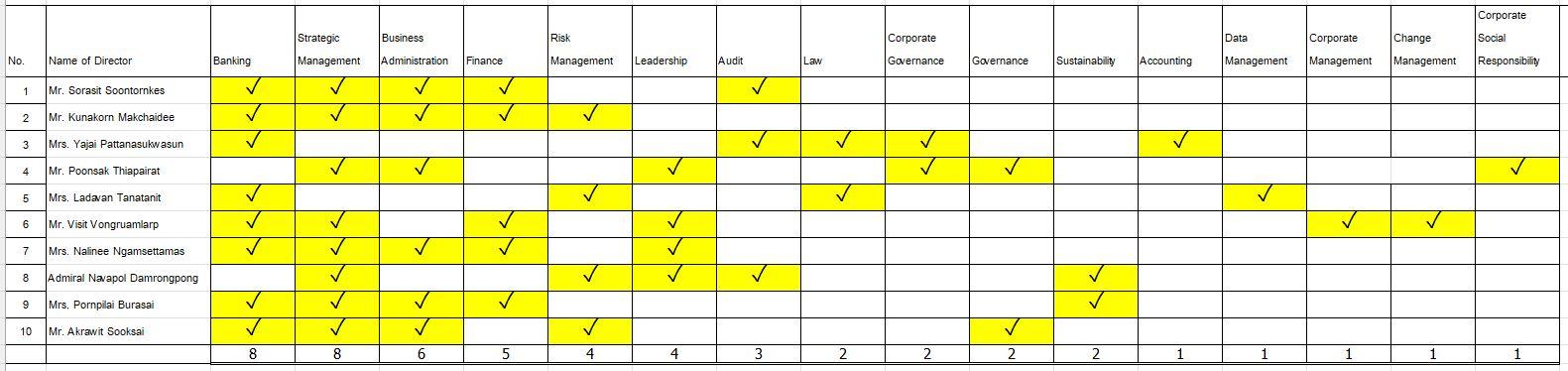
| Other guidelines regarding the board of directors | Board Skills Matrix Policy | Board Skill Matrix of the Board of Directors The Board of Directors places importance on establishing a Board composition that reflects diversity in knowledge, expertise, experience, and skills appropriate to the nature of the Company’s business, as well as alignment with the Company’s strategic direction, business risks, and principles of good corporate governance. This enables the Board to effectively perform its duties in determining policies, providing oversight, and offering strategic guidance to the management. Accordingly, the Company has established a Board Skill Matrix as an important tool for assessing the appropriateness of the Board’s composition. The Board Skill Matrix is used as a framework to:
Previously, the Company defined the Board Skill Matrix under eight key competency areas, which cover the knowledge and experience necessary for overseeing the Company’s business operations, as follows:
Revision of the Board Skill Matrix in Alignment with the 56-1 One Report In 2025, the Company reviewed and revised its Board Skill Matrix to align with the disclosure format prescribed under the 56-1 One Report (Form E) of the Stock Exchange of Thailand. The Company compared the existing skill framework with the list of competencies specified in the form and selected those competencies that are appropriate and relevant to the Company’s business operations. The review identified 19 relevant skill categories, which collectively cover the competencies necessary for effective oversight of the Company’s business. The Board of Directors therefore resolved to adopt these competencies as the Company’s official Board Skill Matrix effective from 2025 onwards. The revision and improvement of the Board Skill Matrix were first reviewed by the Nomination, Remuneration and Corporate Governance Committee (NRC-CG) before being proposed to the Board of Directors for approval. This process ensures that the Company’s Board Skill Matrix remains appropriate, aligned with the Company’s business strategy, and effective as a tool for evaluating the Board’s composition. Core Skills for the Company’s Business Considering the nature of the Company’s business, which primarily involves factoring loans and financial services for entrepreneurs, the Company has identified several core skills essential for business oversight and strategic direction, namely:
These competencies are directly relevant to the factoring business, which requires expertise in credit analysis, liquidity management, trade receivables risk management, and strategic decision-making in the financial services industry. Assessment of the Board’s Expertise The Company conducted an assessment of the knowledge, competencies, and experience of the Board of Directors in accordance with the Board Skill Matrix, taking into consideration each director’s professional background, areas of expertise, and roles and responsibilities.
Based on the Board Skill Matrix assessment as of the end of 2025, the Board of Directors possesses diverse knowledge, expertise, and experience that collectively cover the key competencies relevant to the Company’s business operations. The Board includes directors with expertise in the following areas:
These results reflect that the Board possesses a broad range of knowledge and experience covering the key competencies necessary for overseeing and guiding the Company’s business operations. Furthermore, the Board Skill Matrix assessment indicates that the Board includes directors with sufficient expertise in the core skills essential for the factoring business, namely banking and financial institutions, finance, business administration, strategic management, and risk management. The Company has seven non-executive directors with expertise in these core business skills, who possess experience in finance, financial institutions, lending businesses, risk management, and corporate governance. Their expertise contributes to independent perspectives and effective oversight of the Company’s business operations. The Company currently has one executive director, Mr. Akharawit Suksai, who has extensive experience in managing the Company’s business and related industries. Therefore, the expertise structure of the Board of Directors is consistent with the principles of good corporate governance, with the number of non-executive directors possessing core business expertise exceeding the minimum requirement of at least one director. Utilization of the Board Skill Matrix The Company utilizes the results of the Board Skill Matrix assessment to continuously enhance the Board’s composition, including:
The Board Skill Matrix is reviewed at least once a year by the Nomination, Remuneration and Corporate Governance Committee (NRC-CG) to ensure that the Board’s composition remains appropriate and aligned with the Company’s strategic direction and business environment. | |||||||||
| Other guidelines regarding the board of directors | Directorship in Other Companies Policy | Directorship in Other Companies The Board of Directors places importance on overseeing that directors and executives are able to perform their duties effectively, devote sufficient time to their responsibilities, and exercise their duties with due care, integrity, and in the best interests of the Company and its shareholders in accordance with their fiduciary duties. The Company also seeks to avoid risks arising from excessive commitments and to prevent potential conflicts of interest that may result from holding positions in other companies. The Company has therefore established policies and guidelines regarding the holding of directorships in other companies under the Company’s Corporate Governance Policy, which serves as a framework for overseeing the duties of directors and senior executives. Established Guidelines 1. Limitation on Directorships in Other Listed Companies The Company stipulates that a director may hold directorships in no more than five listed companies on the Stock Exchange of Thailand, without exception. This requirement ensures that directors are able to devote adequate time to performing their duties on the Board of Directors and its sub-committees and to effectively oversee the Company’s operations. 2. Directorships in Other Companies by the Chief Executive Officer The Chief Executive Officer may serve as a director in other companies provided that such positions do not interfere with the performance of duties for the Company. In addition, such companies must not operate in the same line of business as, or compete with, the Company in order to prevent potential conflicts of interest. 3. Prior Approval for Holding Directorships in Other Companies In the event that the Chief Executive Officer intends to accept a directorship in another company, prior approval from the Board of Directors must be obtained before assuming such position. This requirement ensures that the appointment will not give rise to conflicts of interest and will not affect the Company’s corporate governance or management efficiency. Implementation in the Past Year In 2025, the Company continuously monitored and reviewed the directorships held by directors and executives in other companies to ensure compliance with the Company’s Corporate Governance Policy. The review results indicated that:
These practices are in line with the Company’s established policies and reflect the appropriateness of the workload management of directors and executives. They also support effective, transparent corporate governance and ensure that directors and executives are able to perform their duties in the best interests of the Company and its shareholders. | |||||||||
| Other guidelines regarding the board of directors | New Director Orientation | Orientation Program for New Directors The Board of Directors places importance on enhancing the knowledge, understanding, and readiness of directors in performing their duties, particularly newly appointed directors, to ensure that they are able to effectively carry out their oversight responsibilities in accordance with their roles, duties, and responsibilities, as well as the Company’s business context, under the principles of good corporate governance. The Company has established guidelines regarding the orientation program for new directors under the Company’s Corporate Governance Policy and Code of Conduct, with the objective of ensuring that newly appointed directors receive comprehensive information relating to the Company’s organizational structure, corporate governance framework, business strategies, key risks, as well as relevant laws, regulations, and internal policies. This enables directors to perform their duties with due care, integrity, and in the best interests of the Company and all stakeholders. Established Guidelines Orientation Program for New Directors The Company arranges a structured orientation program for newly appointed directors. The program covers key information including the Company’s vision and mission, shareholder structure, corporate governance framework, roles and responsibilities of the Board of Directors and its sub-committees, management structure, key business risks, internal control systems, legal and regulatory compliance, conflict of interest prevention, and policies regarding the prevention of insider trading. Understanding Directors’ Roles and Responsibilities New directors are provided with information regarding their roles, duties, and responsibilities in accordance with fiduciary duties, as well as guidelines relating to ethics, transparency, and compliance with applicable laws and the Company’s policies. This ensures that directors are able to perform their duties independently, prudently, and with accountability. Continuous Development of Directors’ Knowledge The Company encourages directors to participate in training programs, seminars, and knowledge-development activities relating to corporate governance, risk management, information technology, and ESG on an ongoing basis in order to enhance their capabilities in overseeing the Company’s operations in the long term. Implementation in the Past Year In September 2025, the Company organized an orientation program for a newly appointed executive director. During the program, the management team and the Company Secretary provided key information regarding the Company’s business overview, corporate governance structure, roles and responsibilities of the Board of Directors and its sub-committees, risk management framework, internal control system, policies on conflict of interest prevention and insider trading prevention, as well as the Company’s management structure and information technology systems. The orientation program enabled the new director to gain a comprehensive understanding of the roles, responsibilities, and business context of the Company, allowing the director to effectively participate in the Company’s corporate governance from the outset. |
Code of Conduct
Has a Business Code of Conduct
Yes
Code of Conduct Description
Code of Conduct
The Board of Directors recognizes the importance of establishing a Code of Conduct, which serves as an important mechanism for promoting good corporate governance at all levels of the organization. The Code of Conduct is based on principles of integrity, fairness, and ethical business practices, with the objective of ensuring transparent operations and creating fair value for all stakeholders, thereby supporting the Company’s sustainable growth.
To ensure practical implementation, the Company has established this written Code of Conduct as a guideline for directors, executives, and employees to study, understand, and strictly comply with in accordance with the spirit and intent of ethical business conduct.
The Company’s Code of Conduct is divided into three sections, as follows:
Section 1: Corporate Code of Business Conduct
Compliance with laws and adherence to the principles of good corporate governance
Anti-corruption and anti-bribery practices
Prevention of conflicts of interest
Whistleblowing and reporting of misconduct
Responsible business conduct with respect to society and the environment
Treatment of stakeholders with respect for human rights, non-discrimination, and equality, including:
Treatment of shareholders
Treatment of employees
Treatment of customers
Treatment of suppliers and trade creditors
Treatment of financial institution creditors
Treatment of business competitors and dispute resolution
Treatment of government agencies, including tax compliance
Treatment of society, communities, and the environment
Trading of the Company’s securities and the use of insider information for personal gain
Occupational health, safety, and working environment
Reliability and integrity of information
Data protection and confidentiality
Information security, information systems security, and intellectual property protection
Organizational management and internal control
Section 2: Code of Conduct for Directors, Executives, and Employees
Code of conduct for directors
Code of conduct for executives
Code of conduct for employees, including:
Responsibilities toward the Company
Responsibilities toward supervisors, subordinates, and colleagues
Personal conduct and professional behavior
Responsibilities toward customers and business partners
Monitoring and enforcement of compliance
Disciplinary actions
Governance and review mechanisms
Section 3: Supplier Code of Conduct
Compliance with laws and regulations
Conducting business with integrity and due diligence
Anti-corruption and anti-bribery practices
Protection of confidential information and personal data
Fair competition
Respect for intellectual property rights
Management of conflicts of interest
Employment practices and treatment of labor
Environmental responsibility
Communication and Implementation
The Company communicates and disseminates the Code of Conduct through the Company’s website and internal intranet system, ensuring that directors, executives, and employees are informed and encouraged to comply with the established ethical standards. All executives and employees are required to study and understand the Code of Conduct in order to maintain consistent standards of professional conduct across the organization.
Governance and Review
The Nomination, Remuneration and Corporate Governance for Sustainability Committee, as delegated by the Board of Directors, is responsible for reviewing the Company’s Code of Conduct on an annual basis to ensure that it remains appropriate, up to date, and aligned with the Company’s business operations, applicable laws and regulations, and good corporate governance practices.
Statistics
In the past year, no cases were found in which directors or executives of the Company committed violations relating to ethical conduct.
Code of Conduct Link
https://airafactoring.co.th/wp-content/uploads/2025/12/1.1-%E0%B8%88%E0%B8%A3%E0%B8%A3%E0%B8%A2%E0%B8%B2%E0%B8%9A%E0%B8%A3%E0%B8%A3%E0%B8%93%E0%B8%98%E0%B8%B8%E0%B8%A3%E0%B8%81%E0%B8%B4%E0%B8%88.pdf
Page Number in Report
2/25
Code of Conduct Practices
| Guideline | Detail | Document Link | Page Number in Report |
|---|---|---|---|
| Prevention of Misuse of Inside Information | Conflict of Interest Principle The Company has established measures to prevent conflicts of interest by considering transactions that may involve potential conflicts of interest, related party transactions, or connected transactions. Such measures are implemented in accordance with the regulations and guidelines of the Stock Exchange of Thailand (SET) and the Securities and Exchange Commission (SEC). Practices The Company has established the following guidelines to prevent conflicts of interest:
Performance in the Past Year
| https://airafactoring.co.th/wp-content/uploads/2024/12/1.1-%E0%B8%88%E0%B8%A3%E0%B8%A3%E0%B8%A2%E0%B8%B2%E0%B8%9A%E0%B8%A3%E0%B8%A3%E0%B8%93%E0%B8%98%E0%B8%B8%E0%B8%A3%E0%B8%81%E0%B8%B4%E0%B8%88.pdf | 6/25 |
| Anti-corruption | Anti-Corruption Policy and Practices The Company conducts its business based on principles of integrity, transparency, and good corporate governance. The Company has established an Anti-Corruption Policy and adopts a Zero-Tolerance Policy toward corruption in all forms. The Company also strictly complies with applicable laws and regulations in order to prevent any actions that may violate the law, business ethics, or cause damage to the Company, its shareholders, and stakeholders. The Company requires directors, executives, and employees at all levels to uphold ethical standards in conducting business and strictly prohibits the giving or receiving of bribes, gifts, or any other inappropriate benefits, whether directly or indirectly, in order to obtain or retain business or gain an unfair competitive advantage. In addition, the Company encourages its business partners, suppliers, and stakeholders to conduct business with the Company based on principles of transparency, fairness, and ethical business practices. Practices The Company has established systematic guidelines and measures to prevent corruption, including the following key practices:
Corruption Risk Assessment and Management The Company conducts corruption risk assessments as part of its enterprise risk management process. This assessment aims to identify potential corruption risks arising from business operations, operational processes, business transactions, and relationships with business partners and stakeholders. The results of such risk assessments are used to develop appropriate internal control measures and preventive guidelines, ensuring that the Company’s business operations remain transparent and efficient. Oversight and Review The Company assigns the Internal Audit function to review and evaluate the adequacy of the internal control system and to monitor compliance with the anti-corruption policy and related measures on a regular basis. The results of such reviews are reported to the Audit Committee, which oversees the effectiveness of the Company’s internal control system, risk management practices, and compliance with the anti-corruption policy. The Audit Committee also supervises and monitors the implementation of internal control and anti-corruption measures, and the key aspects of such oversight are disclosed in the Audit Committee Report in the Company’s annual report. Anti-Corruption Awareness and Training The Company places importance on raising awareness regarding anti-corruption practices by continuously communicating policies and guidelines to directors, executives, and employees through knowledge sharing activities and internal communication channels. All employees are required to acknowledge and sign the Anti-Corruption Policy annually to confirm their understanding and commitment to comply with the Company’s ethical standards. During the past year, 100% of the Company’s employees acknowledged and signed the Anti-Corruption Policy. Performance in the Past Year During the past year, the Company continuously implemented its anti-corruption policy with the following key outcomes:
| https://airafactoring.co.th/wp-content/uploads/2024/12/1.1-%E0%B8%88%E0%B8%A3%E0%B8%A3%E0%B8%A2%E0%B8%B2%E0%B8%9A%E0%B8%A3%E0%B8%A3%E0%B8%93%E0%B8%98%E0%B8%B8%E0%B8%A3%E0%B8%81%E0%B8%B4%E0%B8%88.pdf | 5/25 |
| Whistleblowing and Protection of Whistleblowers | Whistleblowing and Complaint Handling Principle The Company provides opportunities for its stakeholders to report whistleblowing information and complaints regarding any actions that may violate the Code of Conduct, Anti-Corruption Policy, or other Company policies. Stakeholders may submit complaints or report misconduct through the designated channels so that the Company can investigate the facts and properly consider such complaints. The Company has established three whistleblowing channels, as follows: Channel 1: Company Website Through the Company’s website www.airafactoring.co.th under the section “Contact Us”, selecting the topic “Audit Committee” or “Compliance and Internal Audit Department.” Channel 2: Email or Direct Contact with the Compliance and Internal Audit Department Email to the Audit Committee Email to the Compliance and Internal Audit Department Telephone : +66 2 657 6222 Fax : +66 2 657 6244 Channel 3: Postal Mail Compliance and Internal Audit Department For employees, complaints or suggestions may also be submitted directly to the Board of Directors or management through the Company’s internal email system. Complaint Handling Process The Audit Committee appoints and assigns a working team to collect facts, review and analyze information, and propose appropriate measures to address any violations of the Code of Conduct or related policies. Such findings are submitted to the Audit Committee for consideration in order to determine appropriate actions and mitigate any potential damage to affected parties. The Chairman of the Audit Committee, an independent director, or the Company Secretary will report the matter to the Board of Directors for acknowledgment. If the complainant chooses to disclose his or her identity, the Company will also inform the complainant of the investigation results. Whistleblower Protection Measures Complainants, whistleblowers, and individuals who cooperate in fact-finding investigations are protected by the Company’s whistleblower protection measures. Whistleblowers may choose to remain anonymous if they believe that disclosure of their identity may result in safety concerns or potential harm. If the whistleblower discloses his or her identity, the Company will keep such information strictly confidential and disclose it only when necessary, taking into consideration the safety and protection of the whistleblower and related persons. Appropriate protection measures will be implemented to prevent retaliation against whistleblowers or individuals who provide information. In the event that the accused person is a member of the complaint-handling committee or has any interest related to the complaint, such person must immediately withdraw from the investigation and decision-making process. Performance in the Past Year During the past year, the Company strictly implemented its whistleblowing and complaint-handling policy, with systematic monitoring and verification of information received through all channels. No incidents of fraud, misconduct, or violations of the Code of Conduct or the Anti-Corruption Policy that could adversely affect the Company were reported. Statistics: Improvement and Prevention Measures The Company has established preventive measures to avoid recurrence of potential complaints by strengthening operational processes and internal controls. The Company continuously improves work processes through clearly defined control guidelines and ongoing internal audit monitoring. In addition, the Company has adopted technology and information systems to enhance monitoring processes and reduce operational risks. The Company also provides training and raises awareness among employees regarding proper conduct and compliance with established policies. The Company promotes a transparent organizational culture where employees are encouraged to report irregularities safely and responsibly, thereby enhancing operational efficiency and reducing potential risks in the future. Remediation for Affected Parties The Company places importance on mitigating impacts on affected parties. The Board of Directors will consider appropriate corrective actions based on the level of damage incurred to ensure fair and reasonable resolution. In cases where complaints involve the interests of customers, the Company may implement compensation measures or service improvements in order to address customer concerns, enhance satisfaction, and maintain long-term business relationships. | https://airafactoring.co.th/wp-content/uploads/2024/12/1.1-%E0%B8%88%E0%B8%A3%E0%B8%A3%E0%B8%A2%E0%B8%B2%E0%B8%9A%E0%B8%A3%E0%B8%A3%E0%B8%93%E0%B8%98%E0%B8%B8%E0%B8%A3%E0%B8%81%E0%B8%B4%E0%B8%88.pdf | 7/25 |
| Preventing the Misuse of Inside Information | Insider Information and Securities Trading Policy Principle The Company places great importance on the proper management of inside information that has not yet been disclosed to the public or information that may affect the price of the Company’s securities. The Company strictly prohibits the use of such information for personal benefit or for the benefit of others in an improper manner. The Company considers the misuse of inside information to be a serious matter and has therefore established clear measures and guidelines to prevent the inappropriate use of such information. Practices The Company has established the following practices regarding the use of inside information and securities trading:
Performance in the Past Year During the past year, the Company Secretary communicated via email to directors, executives, and employees, reminding them to avoid using undisclosed information or information that may affect the price of the Company’s securities for personal benefit or for the benefit of others. Such notification was sent during the 30-day period prior to the disclosure of financial statements or other significant information, and all relevant persons were advised to wait at least 48 hours after public disclosure before trading the Company’s securities. Statistics During the past year, no violations relating to the misuse of inside information were identified. | https://airafactoring.co.th/wp-content/uploads/2024/12/1.1-%E0%B8%88%E0%B8%A3%E0%B8%A3%E0%B8%A2%E0%B8%B2%E0%B8%9A%E0%B8%A3%E0%B8%A3%E0%B8%93%E0%B8%98%E0%B8%B8%E0%B8%A3%E0%B8%81%E0%B8%B4%E0%B8%88.pdf | 13/25 |
| Giving or receiving gifts, entertainment, or business entertainment | Gifts, Hospitality, and Donations The Company conducts its business based on principles of transparency, integrity, and ethical business conduct. The Company strictly prohibits requesting or accepting any benefits from customers or business partners in exchange for performing duties or providing preferential treatment. Directors, executives, and employees must not offer or accept gifts, entertainment, hospitality, or other benefits of significant value that may create expectations of improper return benefits or influence business decisions in a manner inconsistent with the Company’s ethical standards. In addition, any donations or sponsorships must be conducted in accordance with the Company’s established policies and procedures to ensure that all such activities are transparent, ethical, and free from hidden benefits or conflicts of interest. Practices The Company has established the following guidelines:
| https://airafactoring.co.th/wp-content/uploads/2024/12/1.1-%E0%B8%88%E0%B8%A3%E0%B8%A3%E0%B8%A2%E0%B8%B2%E0%B8%9A%E0%B8%A3%E0%B8%A3%E0%B8%93%E0%B8%98%E0%B8%B8%E0%B8%A3%E0%B8%81%E0%B8%B4%E0%B8%88.pdf | 20/25 |
| Compliance with laws, rules and regulations | Compliance with Laws and Good Corporate Governance Principle The Company is committed to conducting its business in full compliance with applicable laws, relevant regulations, the Company’s policies and operational procedures, as well as the principles of good corporate governance. Practices The Company has established the following guidelines to ensure compliance:
| https://airafactoring.co.th/wp-content/uploads/2024/12/1.1-%E0%B8%88%E0%B8%A3%E0%B8%A3%E0%B8%A2%E0%B8%B2%E0%B8%9A%E0%B8%A3%E0%B8%A3%E0%B8%93%E0%B8%98%E0%B8%B8%E0%B8%A3%E0%B8%81%E0%B8%B4%E0%B8%88.pdf | 5,15 |
| Use and maintenance of data and assets | Confidential Information and Personal Data Protection Principle Confidential information refers to non-public information or any information that, if disclosed to the public or obtained by competitors, may cause significant damage to the Company. Such confidential information also includes any information provided to the Company by customers and business partners, regardless of its form. The Company recognizes the importance of protecting confidential information and personal data and is committed to ensuring that such information is handled with appropriate care and in accordance with applicable laws and regulations. Practices The Company has established the following guidelines for the protection and management of confidential information and personal data:
| https://airafactoring.co.th/wp-content/uploads/2024/12/1.1-%E0%B8%88%E0%B8%A3%E0%B8%A3%E0%B8%A2%E0%B8%B2%E0%B8%9A%E0%B8%A3%E0%B8%A3%E0%B8%93%E0%B8%98%E0%B8%B8%E0%B8%A3%E0%B8%81%E0%B8%B4%E0%B8%88.pdf | 14,20 |
| Anti-competitive | Fair Competition Principle The Company conducts its business under the principles of free and fair competition, operating within the framework of applicable laws and regulations governing business competition. Practices The Company has established the following guidelines regarding fair competition:
| https://airafactoring.co.th/wp-content/uploads/2024/12/1.1-%E0%B8%88%E0%B8%A3%E0%B8%A3%E0%B8%A2%E0%B8%B2%E0%B8%9A%E0%B8%A3%E0%B8%A3%E0%B8%93%E0%B8%98%E0%B8%B8%E0%B8%A3%E0%B8%81%E0%B8%B4%E0%B8%88.pdf | 11/25 |
| Cyber security | Information Security and Intellectual Property Principle The Company recognizes the importance of information, information systems, and intellectual property as key factors that support efficient business operations. The Company is also aware of potential risks arising from information security threats and therefore emphasizes maintaining the security, reliability, and integrity of its information technology operations. The Company is committed to implementing appropriate measures to safeguard information systems and intellectual property in order to ensure secure and reliable business operations. Practices The Company has established the following practices:
| https://airafactoring.co.th/wp-content/uploads/2024/12/1.1-%E0%B8%88%E0%B8%A3%E0%B8%A3%E0%B8%A2%E0%B8%B2%E0%B8%9A%E0%B8%A3%E0%B8%A3%E0%B8%93%E0%B8%98%E0%B8%B8%E0%B8%A3%E0%B8%81%E0%B8%B4%E0%B8%88.pdf | 15/25 |
| Environmental management | Social Responsibility and Sustainable Development Principle The Company is committed to becoming an organization that promotes sustainable development, creating economic value while minimizing environmental impacts and improving the quality of life for society. The Company conducts its business under the principles of good corporate governance and ethical business practices, while continuously supporting activities that contribute to communities and society. In conducting its business operations, the Company emphasizes social responsibility and carefully considers any actions that may affect public interest. Practices The Company has established the following practices:
| https://airafactoring.co.th/wp-content/uploads/2024/12/1.1-%E0%B8%88%E0%B8%A3%E0%B8%A3%E0%B8%A2%E0%B8%B2%E0%B8%9A%E0%B8%A3%E0%B8%A3%E0%B8%93%E0%B8%98%E0%B8%B8%E0%B8%A3%E0%B8%81%E0%B8%B4%E0%B8%88.pdf | 8,10 |
| Human rights | Human Rights Policy and Practices Human Rights Policy The Company places importance on respecting human rights of all stakeholder groups and conducts its business in accordance with the principles of good corporate governance, business ethics, and social responsibility. The Company complies with relevant laws and regulations relating to labor protection, personal data protection, and non-discrimination. The Company is committed to conducting business with respect for human dignity, equality, and fundamental rights, taking into consideration stakeholders involved throughout the Company’s business operations, including employees, customers, business partners, and other relevant stakeholders. Human Rights Risk Prevention and Mitigation Measures The Company has established policies and governance mechanisms to prevent human rights violations, covering the following key areas:
The Company promotes employment and human resource management based on competence, equality, and fairness, without discrimination in recruitment, employment, compensation, or promotion.
The Company does not support the use of child labor or forced labor in any form and strictly complies with applicable labor laws. The Company also encourages its business partners to adhere to the same principles.
The Company treats employees and stakeholders fairly and equally, without discrimination based on gender, age, race, religion, political views, health condition, or other factors as defined by law. The Company also promotes an organizational culture that respects diversity.
The Company is committed to maintaining a safe and respectful working environment by establishing measures to prevent and address harassment in all forms, including physical, verbal, psychological, and sexual harassment.
The Company provides appropriate employee welfare in accordance with labor law standards and places importance on occupational health and safety, ensuring that employees can work in a safe environment with a good quality of life.
The Company promotes awareness of human rights principles through communication and training programs for employees on human rights, business ethics, and the prevention of human rights violations, fostering an organizational culture that respects the rights of others. Measures to Prevent Human Rights Violations The Company has implemented measures to prevent and manage risks related to potential human rights violations in its business operations, including:
Complaint Mechanism and Whistleblower Protection The Company has established channels for receiving complaints or whistleblowing reports regarding actions that may involve human rights violations, corruption, or unethical conduct. Employees and stakeholders may report concerns through the Company’s designated channels. The Company places importance on protecting whistleblowers by ensuring confidentiality of information and implementing measures to prevent retaliation or harassment. Complaints are investigated through a fair, transparent, and verifiable process. Remediation Measures If incidents related to human rights violations are identified, the Company will conduct a fair and transparent investigation and implement corrective and preventive measures to prevent recurrence. The Company may also provide appropriate remedial support or assistance to affected parties, where applicable. Human Rights Complaint Statistics During the past year, no complaints or legal cases related to human rights violations were reported in the Company’s business operations. Future Development on Human Rights Management Although no human rights complaints were received during the past year, the Company remains committed to continuously improving its human rights management practices. The Company plans to develop a Human Rights Risk Assessment process in order to strengthen human rights due diligence across its business operations in the future. | https://airafactoring.co.th/wp-content/uploads/2024/12/1.1-%E0%B8%88%E0%B8%A3%E0%B8%A3%E0%B8%A2%E0%B8%B2%E0%B8%9A%E0%B8%A3%E0%B8%A3%E0%B8%93%E0%B8%98%E0%B8%B8%E0%B8%A3%E0%B8%81%E0%B8%B4%E0%B8%88.pdf | 8/25 |
| Occupational health and safety | Principles: The company prioritizes the health and safety of its employees, which is a crucial factor in fostering morale and efficient, high-quality operations. Therefore, the company is committed to developing a safety, occupational health, and working environment management system that complies with relevant laws and regulations.
• Support and promote the improvement of the work environment and safe work practices, including the good health and hygiene of all employees. • Enhance the knowledge and awareness of all employees to work safely and maintain good occupational hygiene. • Support and promote workplace safety activities to maximize practical outcomes for all parties. | https://airafactoring.co.th/wp-content/uploads/2024/12/1.1-%E0%B8%88%E0%B8%A3%E0%B8%A3%E0%B8%A2%E0%B8%B2%E0%B8%9A%E0%B8%A3%E0%B8%A3%E0%B8%93%E0%B8%98%E0%B8%B8%E0%B8%A3%E0%B8%81%E0%B8%B4%E0%B8%88.pdf | 13/25 |
Promoting Compliance with the Code of Conduct
Promotes Compliance by Directors, Executives and Employees
Yes
Description
Process for Promoting Compliance with the Code of Conduct
The Company has established a systematic approach to promote strict compliance with the Code of Conduct among directors, executives, and employees. Clear roles and responsibilities are defined at each level of the organization as follows:
1. Acknowledgement and Compliance with the Code of Conduct
It is the duty and responsibility of all directors, executives, and employees to acknowledge, understand, and strictly comply with the Company’s Code of Conduct.
The Code of Conduct is considered a mandatory disciplinary framework. Any violation of the Code of Conduct is regarded as a breach of the Company’s policies and ethical standards and may result in disciplinary actions in accordance with the Company’s work regulations.
2. Role of Executives in Oversight
Executives at all levels are responsible for supervising and encouraging employees under their supervision to acknowledge, understand, and strictly comply with the Company’s Code of Conduct.
3. Consultation and Guidance Channels
In the event of uncertainty regarding compliance with the Company’s Code of Conduct, employees may seek guidance directly from their supervisors.
Employees may also consult the Compliance and Internal Audit Department, which is responsible for providing clarification and guidance on appropriate practices.
4. Review and Monitoring of Compliance
Management is responsible for reviewing the Code of Conduct and considering appropriate mechanisms for monitoring compliance.
The Code of Conduct is reviewed and updated annually to ensure its relevance to changes in the business environment. Any revisions will be proposed to the Board of Directors for consideration and approval.
In the event of any changes, management must submit the proposed revisions to the Board of Directors for approval and ensure timely implementation.
5. Oversight and Monitoring
The Audit Committee is responsible for overseeing and monitoring the implementation of the Code of Conduct.
The Compliance and Internal Audit Department regularly reviews the Company’s internal control systems and operational processes to ensure compliance with the Code of Conduct.
The Compliance and Internal Audit Department will discuss audit findings with relevant parties to determine appropriate corrective actions and report the results to management and the Audit Committee accordingly.
Performance in 2025
In 2025, the Company continuously communicated and promoted awareness of business ethics and the Code of Conduct to directors, executives, and employees.
100% of the Board of Directors received communication regarding the Company’s Code of Conduct.
100% of executives and employees received communication and guidance regarding the Code of Conduct.
During the year, no cases of misconduct relating to the Company’s business ethics were identified.
Process Document Link
https://airafactoring.co.th/wp-content/uploads/2025/12/1.1-%E0%B8%88%E0%B8%A3%E0%B8%A3%E0%B8%A2%E0%B8%B2%E0%B8%9A%E0%B8%A3%E0%B8%A3%E0%B8%93%E0%B8%98%E0%B8%B8%E0%B8%A3%E0%B8%81%E0%B8%B4%E0%B8%88.pdf
Page Number in Report
21/25
Anti-Corruption Networks & Projects
Joined or Declared Intent to Join Anti-Corruption Networks
Yes
Networks & Projects Joined
| Network / Project | CAC Certified |
|---|---|
| Thai Private Sector Collective Action Against Corruption: CAC | Y |
| United Nations Global Compact (UNGC) | |
| Participation of anti-Corruption networks and initiatives |
Material Changes & Developments in CG
Reviewed the CG Policy or Board Charter in the Past Year
Yes
Material Changes or Developments in the Past Year
Yes
Policy Review — Description
Review of Corporate Governance Charters, Policies, and Practices
In 2025, the Company continued to strengthen its corporate governance framework by conducting annual reviews of the Board Charter, corporate governance policies, and related practices, as well as reviewing them whenever necessary. This ensures that such governance documents remain appropriate, up to date, and aligned with applicable laws, regulatory requirements, and the Corporate Governance Code for Listed Companies 2017 (CG Code).
During the year, the Company conducted an annual review of the Board of Directors Charter and the charters of its subcommittees. The review concluded that the contents remained comprehensive and appropriately reflected the roles, duties, and responsibilities of the Board of Directors in accordance with good corporate governance practices. Therefore, it was deemed appropriate to maintain the existing charters without amendment. The results of the review were subsequently submitted to the Board of Directors for consideration and acknowledgement in accordance with the established procedures.
In addition, the Company conducted annual reviews of all corporate governance-related policies. In 2025, several key policies were reviewed and enhanced to further strengthen the Company’s governance framework. These included improvements to the Whistleblowing and Complaint Handling Policy to enhance clarity, transparency, and practical implementation, in preparation for the Company’s second renewal of certification under the Private Sector Collective Action Against Corruption (CAC).
The Company also established a Disclosure and Investor Relations Policy, and revised the Management Succession Planning Policy to ensure alignment with the Company’s governance framework and international best practices.
With regard to governance mechanisms, the Company reviewed and improved key governance tools, including the Board of Directors’ performance evaluation form and the Chief Executive Officer performance evaluation form, as well as the Board Skill Matrix, to align with disclosure requirements under the 56-1 One Report framework. These improvements enhance the effectiveness of board oversight, performance evaluation, and systematic board development.
The annual review of charters, policies, and governance practices reflects the Company’s strong commitment to continuously improving its corporate governance framework, enhancing governance standards in accordance with the CG Code, and strengthening confidence among shareholders, investors, and all stakeholders.
Implements the CG Code for Listed Companies
No
CG Code — Description
Adoption of the Corporate Governance Code (CG Code)
In 2025, the Board of Directors adopted the Corporate Governance Code for Listed Companies (CG Code) issued by the Securities and Exchange Commission (SEC) as a key framework for corporate governance, policy formulation, and oversight of the Company's operations on an ongoing basis. This is to ensure that the Company’s management is conducted with transparency, accountability, and due regard for the rights of shareholders and all stakeholder groups, while supporting the Company's sustainable and long-term growth.
The Board of Directors regularly reviews the implementation of the CG Code and has assigned the management team and relevant Board Committees to monitor the progress of such implementation and report to the Board of Directors as appropriate. The Company has adopted the CG Code principles in most respects, particularly in the following key areas:
Protection of shareholder rights and equitable treatment of shareholders
Roles toward stakeholders and sustainable business development
Disclosure of information and transparency
Responsibilities of the Board of Directors
1. Shareholder Rights and Equitable Treatment of Shareholders
The Company promotes the full exercise of shareholder rights without restriction or infringement. Shareholders are provided with appropriate, sufficient, and timely information and are able to participate in meetings, vote, and express opinions on an equitable basis.
Shareholders have the right to participate in decision-making on significant matters of the Company, including dividend payments, appointment or removal of directors, determination of directors’ remuneration, appointment and remuneration of auditors, and approval of significant transactions in accordance with applicable laws and regulations.
2025 Annual General Meeting of Shareholders (E-AGM)
The Company held the 2025 Annual General Meeting of Shareholders on Monday, 21 April 2025 at 10:00 a.m. via electronic means (E-AGM) in accordance with the Emergency Decree on Electronic Meetings B.E. 2563 (2020) and related laws. This approach facilitated convenient participation and ensured that shareholders could exercise their rights thoroughly and equitably.
Advance Notice of Meeting and Supporting Documents
The notice of the meeting dated 13 March 2025, together with complete supporting documents, was delivered to shareholders in advance. Such documents included the Annual Registration Statement / Annual Report (56-1 One Report) in QR Code format, information on director nominees, qualifications of independent directors, the list of independent directors available for proxy appointment, relevant articles of association, and proxy forms A and B.
These materials were also published on the Company's website to provide shareholders with sufficient time to review the information before making decisions.
Record Date
The Company determined 4 March 2025 as the Record Date for shareholders entitled to attend the 2025 Annual General Meeting of Shareholders.
Facilitation of Meeting Participation, Proxy Appointment, and Voting
The Company provided shareholders with the ability to attend the meeting and vote via the IR PLUS AGM system through both Mobile Application and Web Application platforms. Clear procedures for registration, identity verification, and voting instructions were provided to ensure that shareholders could exercise their rights accurately, conveniently, and efficiently.
Shareholder Proposal of Agenda and Director Nomination
The Company provided shareholders with the opportunity to propose meeting agenda items and nominate qualified candidates for election as directors in advance in accordance with the established criteria. Information regarding such rights was disclosed through the Company's investor relations channels. However, no shareholder proposed any agenda items for the 2025 Annual General Meeting.
Transparency During and After the Meeting
The Company prepared and disclosed the minutes of the shareholders’ meeting through a transparent and verifiable process. The minutes of the 2025 Annual General Meeting clearly specified the date, time, and format of the meeting conducted via electronic means, allowing shareholders to review and monitor the meeting outcomes appropriately.
2. Roles Toward Stakeholders and Sustainable Business Development
The Company recognizes the importance of all stakeholder groups throughout the business value chain and has established clear guidelines for the treatment of stakeholders under its corporate governance policy. This ensures that each stakeholder group is treated fairly and appropriately in accordance with their rights, obligations, and agreements.
The Board of Directors and relevant management oversee and monitor the implementation of such policies and practices.
The Company has established channels for receiving feedback, suggestions, and complaints through appropriate, transparent, and verifiable mechanisms. The information obtained is analyzed and utilized to continuously improve operational processes, service quality, and management practices, thereby supporting responsible and sustainable business operations in the long term.
3. Disclosure of Information and Transparency
The Company places importance on the accurate, complete, transparent, and timely disclosure of both financial and non-financial information through accessible and reliable channels, including the Stock Exchange of Thailand, the Annual Registration Statement / Annual Report (56-1 One Report), and the Company's website in both Thai and English.
This ensures that shareholders and investors have sufficient information for informed decision-making.
The Company has also established clear procedures and practices for information disclosure in both normal and urgent situations under the oversight of the Board of Directors and relevant management to ensure fairness, equal access, and compliance with applicable laws and regulatory requirements.
4. Responsibilities of the Board of Directors
The Board of Directors determines the term of office of directors in accordance with the Company's Articles of Association and oversees that Board meetings are conducted in an appropriate manner. Notices of meetings, agendas, and supporting documents are distributed in advance to allow directors sufficient time to review information and provide thoughtful input.
The Board places significant emphasis on strategic oversight, performance monitoring, and risk management. It also oversees the management of conflicts of interest by requiring directors or executives with vested interests to disclose such interests prior to consideration and abstain from voting on related agenda items. Such disclosures are recorded in the meeting minutes.
In addition, the Company promotes orientation programs for newly appointed directors to ensure that they have a clear understanding of their roles and responsibilities, key policies, and the Company's business operations. This enables them to perform their duties effectively and in line with good corporate governance principles.
Areas Where the Company Has Not Fully Adopted Certain CG Code Principles
In 2025, the Company considered the adoption of the CG Code principles in alignment with its organizational structure and operational context. However, certain principles have not been fully adopted, with explanations as follows:
1. Independent Directors Serving More Than 9 Years
The Company has not imposed a limitation that independent directors must serve no longer than nine years. The Board of Directors considers that tenure alone does not necessarily diminish independence, provided that independent directors continue to perform their duties and provide opinions independently without conflicts of interest.
All independent directors of the Company continue to possess qualifications in accordance with the Company's criteria and the regulations of the Capital Market Supervisory Board, and they bring valuable knowledge, expertise, and experience to the Company's governance and business operations.
2. Prior Notification of Securities Trading by Directors and Senior Executives
The Company does not require directors and senior executives to notify the Board of Directors at least one business day in advance before trading the Company's securities. Nevertheless, directors and executives are required to strictly comply with all relevant laws, regulations, and supervisory requirements, including the Company's policy on the use of inside information and reporting of securities transactions as required by law.
3. Disclosure of Chief Executive Officer Remuneration
The Company does not disclose the remuneration of the Chief Executive Officer separately from that of other senior executives. Instead, remuneration is presented on an aggregated basis in accordance with the Company's management structure, remuneration policy, and disclosure practices.
However, executive remuneration is considered and overseen by the relevant Board Committee in accordance with established principles to ensure appropriateness and fairness.
Other CG Performance & Outcomes
Corporate Governance Recognition
In 2025, the Board of Directors continued to place strong emphasis on promoting and enhancing good corporate governance practices. The Company remains committed to operating under the principles of transparency, accountability, fairness, and consideration of all stakeholder groups. The Company has systematically integrated good corporate governance principles into its policies, governance processes, and operational practices to ensure alignment with regulatory requirements and internationally recognized best practices.
As a result of these ongoing efforts, the Company has continuously received positive evaluations and recognition in corporate governance from external organizations. These recognitions reflect the strength of the Company’s governance structure and its consistent adherence to good corporate governance principles. In 2025, the Company received the following notable recognitions:
AGM Checklist Assessment
The Company achieved a full score of 100 points in the 2025 Annual General Meeting Quality Assessment Program (AGM Checklist). The assessment was organized by the Thai Investors Association (TIA) in collaboration with the Securities and Exchange Commission (SEC) and the Thai Listed Companies Association (TLCA).
This recognition reflects the Company’s commitment to conducting shareholder meetings with transparency, fairness, and efficiency, while facilitating shareholders’ ability to exercise their rights fully and equitably.
Corporate Governance Report (CGR)
The Company received an “Excellent” rating with a 5-Star symbol in the Corporate Governance Report of Thai Listed Companies (CGR) 2025, conducted by the Thai Institute of Directors Association (IOD).
The Company has maintained this 5-Star Excellent rating for six consecutive years, demonstrating its consistent commitment to maintaining high standards of corporate governance and effective governance practices.
The above recognitions reflect the strong commitment of the Board of Directors, management, and employees at all levels to continuously enhance the Company’s corporate governance standards in line with international practices. This commitment aims to strengthen confidence among shareholders, investors, and all stakeholders while supporting the Company’s stable and sustainable long-term growth.